High Pressure, Hard Lessons, and Forward Progress at the Quiberon World Championships
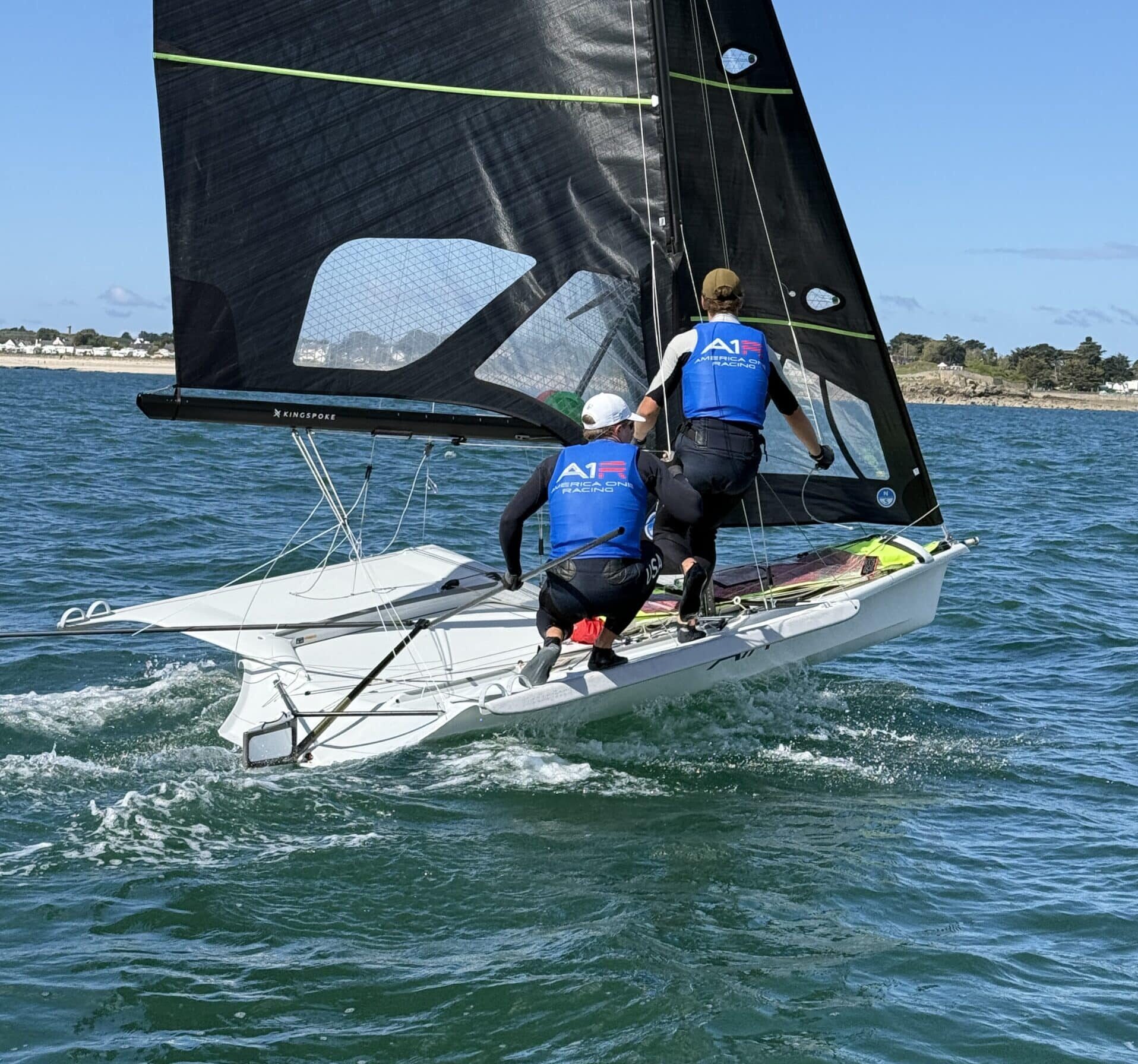
The 2026 World Championship for the 49er and 49erFX classes in Quiberon, France marked the third and final stop of an intense spring European campaign for America One Racing (A1R). Following three major events in rapid succession, athletes faced some of the most physically and mentally demanding conditions of the season at one of sailing’s most iconic venues. Windy, unstable offshore breeze and constantly shifting conditions defined the championship week, testing every aspect of performance across all three Olympic fleets.
The regatta also reinforced one of the central philosophies within A1R: continuous improvement requires constant evaluation, adaptation and resilience. While the results sheet did not ultimately reflect the ambitions of the A1R teams, Quiberon delivered valuable lessons that will shape the next phase of training and development heading into the European Championships later this summer.
In the 49er fleet, the week once again highlighted the extraordinary depth and unpredictability of modern skiff racing. Across the three major European events this spring, podiums shifted dramatically from regatta to regatta, with teams missing Gold Fleet at one event only to contend for medals at the next.
Coming into Quiberon, A1R athletes Nevin Snow and Ian MacDiarmid carried tremendous momentum after silver and fourth-place finishes at the previous two major events in Europe. Their earlier performances showcased not only exceptional speed, but also the communication, tactical sharpness and composure that have become hallmarks of their campaign.
Quiberon, however, exposed just how unforgiving Olympic skiff racing can be. Challenging starts throughout much of the regatta and the inability to consistently capitalize on their usually strong upwind tactical positioning left Snow and MacDiarmid fighting from behind in the highly competitive 82-boat fleet. Despite flashes of truly impressive downwind pace and race management, they ultimately finished 21st overall.
For the team, the result was disappointing, but also instructive. In a fleet where even minor mistakes are magnified immediately, Quiberon became another reminder that sustaining advanced-level consistency requires relentless refinement in every area of performance. The experience reinforced the importance of process, preparation and the ability to reset quickly under pressure.
“While the results weren’t what we came here aiming for, there were still a lot of important positives to take away;” notes Head Coach Charlie McKee. “Across the fleets, our athletes continued to show determination, composure under pressure, and a willingness to keep learning in some extremely difficult conditions. That mindset is critical at this level.”
The 49erFX team of Paris Porter (Henken) and Helena Scutt experienced a similarly challenging championship – though under particularly unique circumstances. Henken arrived in France having celebrated her long-awaited wedding just days before the regatta, giving the event a very different feel from a traditional championship build-up. With limited preparation time together leading into the competition, the team approached Quiberon understanding that the week would serve not only as a world championship, but also as an important training and development opportunity within the broader Olympic campaign.
Rather than viewing the lack of practice as a setback alone, the regatta became a valuable reminder that continuous improvement at A1R depends on maintaining communications, rhythm and consistent time on the water together. Even with the excitement and emotion surrounding Henken’s wedding, both sailors embraced the week as an opportunity to recalibrate and continue strengthening their partnership.
The challenges came quickly. Several over-early starts and an untimely collision created an inconsistent scoreline early in the regatta. Like their A1R teammates, Henken and Scutt showed strong downwind speed and confident heavy-air boat handling, but the mistakes proved costly in an incredibly tight fleet. They missed Gold Fleet by a single point.
What followed, however, became one of the most encouraging performances of the week. Resetting mentally after narrowly missing the Gold Fleet cut, Henken and Scutt dominated the Silver Fleet series in commanding fashion, showcasing the resilience, teamwork and composure that continue to define their campaign. Their response under disappointment reflected the kind of mental toughness that A1R places at the center of long-term athlete development.
Across the A1R teams, one theme consistently emerged from Quiberon: resilience. World championships are designed to expose weaknesses, challenge preparation and force athletes to adapt in real time. The ability to absorb setbacks, learn quickly and continue building confidence through adversity remains one of the most critical components of Olympic- level campaigning.
That mindset has become central to the A1R philosophy. While no athlete leaves an event satisfied with results below expectations, difficult regattas often become some of the most important moments in a campaign. The discipline to reset after tough races, trust the process, and continue improving under pressure is every bit as important as raw speed around the racecourse.
All of the athletes now enter a planned rest and recovery phase, which will include a comprehensive review of the spring European events. Based on that analysis and performance data, refinements to training plans will be implemented as teams begin preparing for the European Championships in July.
McKee stresses the long game approach at A1R. “One of the things we emphasize within America One Racing is that progress is rarely linear. The teams that ultimately succeed are the ones that can absorb setbacks, evaluate honestly, reset quickly, and continue improving day after day. Quiberon gave us valuable information about where we’re strong and where we need to keep refining. I’m proud of the way our athletes continued fighting throughout the week and how they supported one another through adversity. We’ll take these lessons into the next training phase as we prepare for the European Championships later this summer.”
As the Olympic-class season continues, Quiberon will likely be remembered not simply for finishing positions, but as another important development point for these A1R teams – one that reinforced the value of critical skills such as preparation…adaptability…partnership…and resilience on the road ahead.